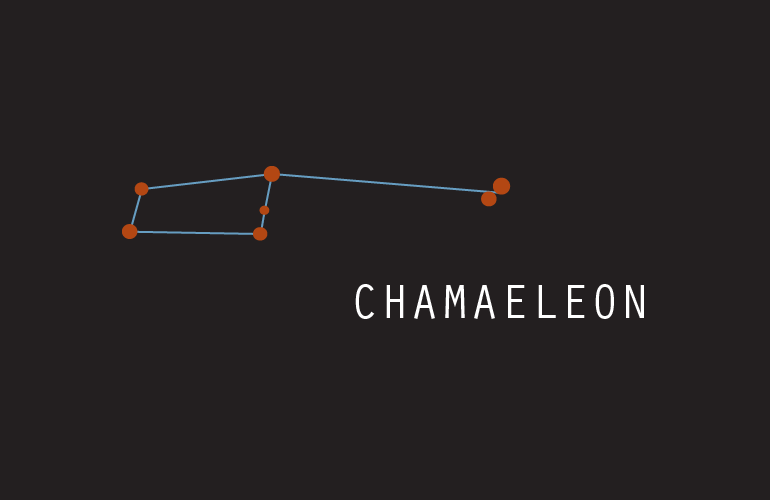
88 constellations under Observation/The Night Sky.
This site is a testament that even though I have a physical disability - legally blind - I can still do things that helps other people.
This site stands as proof that, despite being legally blind, I can still contribute in meaningful ways.
I also have a new image gallery. I call it Second Site Image Gallery.
Understanding Distance: From Interstellar Travel to Cross-Country Moving
ISS Tracker
Check Grab My Essay which is one of the best essay writing services
Find on Top Writers Review your essay writing company
PickWriters provides the best translation services reviews
Find on LetsGradeIt best reviews on essay writing services
This is an educational website. It's never too late to learn astronomy, even for those who have not completed their primary (High School) education. A GED can get you in the door to college level courses.
How to Maximize Early Momentum on TikTok for Viral Reach
|
Affordable academic writing company CheapWritingHelp.com provides students with unique astronomy research papers and science essays.
A-Writer essay writing service with the best PhD writers on Astronomy.
Stargazing to Star Charts: Engaging Students in the Wonders of Astronomy
Space nerds, take the giant leap! Designing a celestial wedding for star struck lovers
|
|
APOD: Supernova Remnant Pa 30
International Gemini Observatory/NOIRLab/NSF/AURA. Acknowledgment: PI: T. Cunningham (Center for Astrophysics - Harvard & Smithsonian). Image Processing: J. Miller & M. Rodriguez (International Gemini Observatory/NSF NOIRLab), T.A. Rector (University of Alaska Anchorage/NSF NOIRLab), D. de Martin & M. Zamani (NSF NOIRLab). Supernova Remnant Pa 30
International Gemini Observatory/NOIRLab/NSF/AURA. Acknowledgment: PI: T. Cunningham (Center for Astrophysics - Harvard & Smithsonian). Image Processing: J. Miller & M. Rodriguez (International Gemini Observatory/NSF NOIRLab), T.A. Rector (University of Alaska Anchorage/NSF NOIRLab), D. de Martin & M. Zamani (NSF NOIRLab).
Explanation: "Happy New Year!" No, wait, this is not a fireworks display. This image shows Nebula Pa 30, observed with the Gemini North Telescope in Hawai'i. It is likely the remnant of an old supernova explosion: separate historical records by Chinese, Japanese and Arabic astronomers tell of a "guest star" that appeared in the sky for 185 days in the year 1181. It is believed that this bright new point of light came from the supernova that caused the fireworks in Pa 30. Astronomers don't know exactly what happened in this unusual explosion, classified as a Type Iax supernova, but it is thought to be caused by the merger of two white dwarfs. The mysterious central star in the image is extremely hot and produces a strong wind, possibly forming the radial filaments. Look closely at them: those pearl-like knots stringing the filaments are 4 light-days in diameter. Understanding how a supernova created this amazing nebula continues an 845-year old mystery (and counting).
|
A Student's Guide on How to Tackle Complex Astronomy Assignments
Navigating the Final Frontier: Understanding Space Law in the Age of Commercial Space Flight
Why Planning Your Day Fails - and What Actually Helps You Stay Consistent
How Not to Let Astrology Affect Your Life
|
|
APOD: Lunar Farsides Lunar Farsides
NASA / GSFC / Arizona State Univ. / Lunar Reconnaissance Orbiter
Explanation: Tidally locked in synchronous rotation, the Moon always presents its familiar nearside to denizens of planet Earth. From lunar orbit, the Moon's farside can become familiar, though. In fact this sharp picture, a mosaic from the Lunar Reconnaissance Orbiter's wide angle camera, is centered on the lunar farside. Part of a global mosaic of over 15,000 images acquired between November 2009 and February 2011, the highest resolution version shows features at a scale of 100 meters per pixel. Surprisingly, the rough and battered surface of the farside looks very different from the nearside covered with smooth dark lunar maria. A likely explanation is that the farside crust is thicker, making it harder for molten material from the interior to flow to the surface and form dark, smooth maria.
|
Astronomy in the Classroom: Engaging Students In Interesting Lessons
Is It Fate In The Sky, Or Merely A Mirror Of What We So Desperately Want To Believe?
|
|
APOD: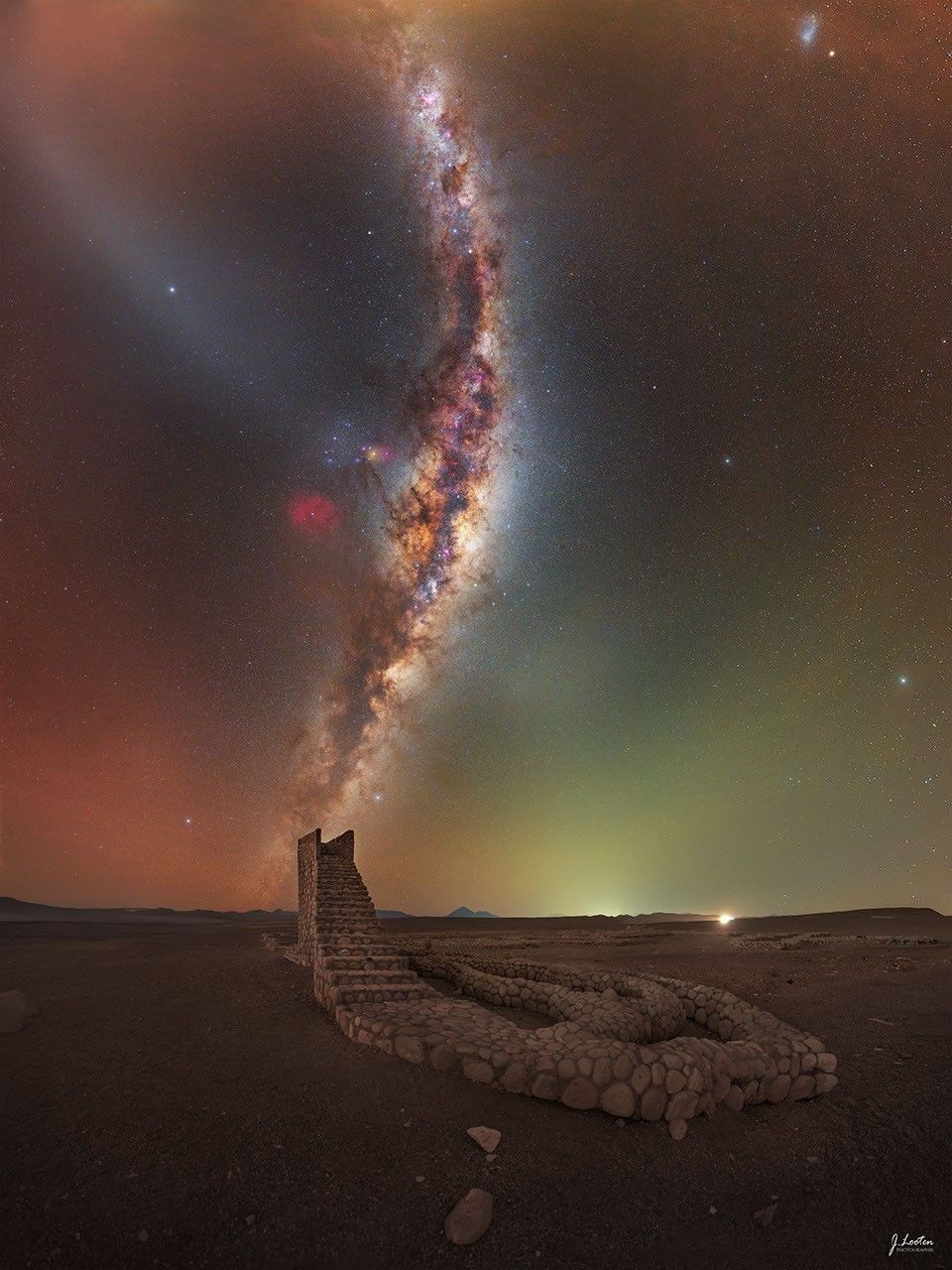 Desert Stairway to Heaven
Julien Looten Desert Stairway to Heaven
Julien Looten
Explanation: This stairway in Chile brings you only a little bit closer to heaven. But ooh, the sky above it makes you wonder. For example, you may wonder about the dark lane of our own Milky Way galaxy rising behind the expansive Atacama Desert in Chile, the band of zodiacal light on the upper left, the green and red airglow just above the horizon, the star Spica in the zodiacal light stripe, and, at the very top on the right, the Small Magellanic Cloud galaxy. The Desert Staircase sculpture is in the foreground, and this image was timed to catch the picturesque peering perch just in front of the near-vertical Milky Way band. Upon close inspection of the horizon you can find, left to right, some Andes Mountains, the Licancabur volcano, and the town lights of San Pedro de Atacama. The featured wide-angle composite was captured in July 2025.
|
How the Website
is Organized:
Advertising within text will be in italics with a link to the ad source.
Observation - This section includes information on
coordinate systems, constellations, objects visible in the
night sky, and some images of the night sky of the
northern and southern hemispheres.
Science - This section includes information on some
of the basic science used in astronomy. There is information
on the variety of tools used (like telescopes) as well as
methods of using them. There is a mathematics primer,
introduction to some physical processes, formulas used in
astronomy, and information on computer use in Astronomy.
Solar System
- As indicated, this section covers our Solar System and everything in it. It covers the Sun, planets, their moons, asteroids, comets and exotic objects like TNO's and Kuiper Belt Objects.
Stars - This section covers stars in our own galaxy.
It covers the variety of stellar evolution paths. It also
covers supernova, black holes, and some of the radiative
processes in the interstellar medium.
Our Galaxy
- This section covers our galaxy as well as some of the
nearby galaxies in our own Local Group. It also covers
galaxy evolution.
Cosmology
- This section covers other galaxies and galaxies clusters.
It also covers the big bang, relativity and dark matter.
Astrobiology
- This section covers the relatively new field in astronomy
- the possibility of life in our Solar System and the
Universe. There is also information on some of the projects
dealing with this - like SETI.
Exoplanets
- This section covers the study of planets known to exist
around other stars. It covers both amateur and professional
involvement and shows you how you can get involved with the
search as well.
Astrophotography -
This section covers the fastest growing hobby of
astrophotography. This section offers information and tips
on photography and also features and Image Gallery.






 English
 Farsi
Farsi